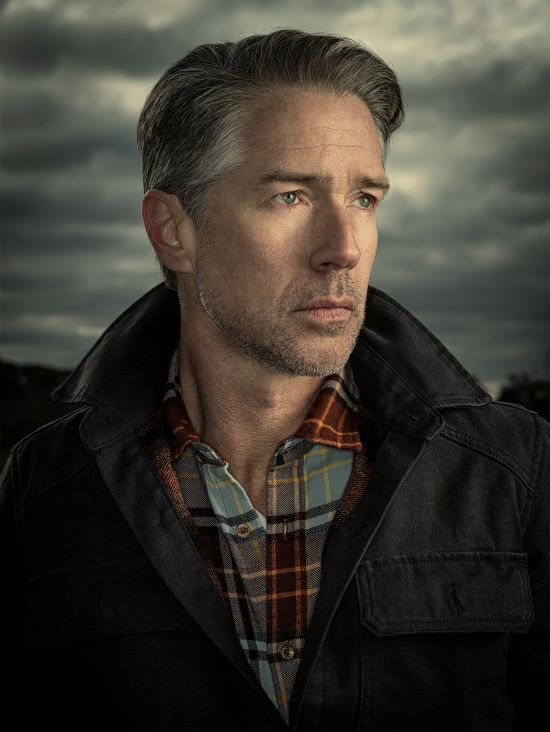
Thomas Woltz, Senior Principal of Nelson Byrd Woltz Landscape Architects (NBW), believes the impact and importance of public landscapes can’t be overstated. Yes, a well-tended public landscape can help with issues such as erosion control, but Woltz sees how public landscapes can boost the health of both a city and its residents.
Woltz will be the featured speaker at 2026 Philip A. Morris Fund for the Design Arts Annual Lecture on Thursday, Oct. 8. His talk on the importance of public landscapes will help celebrate 100 years of the Olmsted Parks System for Birmingham. The Philip A. Morris Fund for Design Arts is a Field of Interest Fund at the Community Foundation of Greater Birmingham dedicated to creating and expanding awareness of the design arts and the impact of quality design in our community.
Woltz, recognized by Fast Company as one of the most creative people in business, leads his firm in the artful creation and revitalization of public landscapes with an approach that is collaborative and research based. Working at the intersection of culture and ecology for the sustainability of the public realm, NBW has led projects across 30 states and 12 countries.
We spoke with Woltz about the importance of public landscapes and what to expect from his upcoming lecture.
The 2026 Philip A. Morris Fund for the Design Arts Annual Lecture featuring Thomas Woltz is set for 11 a.m. Thursday, Oct. 8 and will be held in the Birmingham Botanical Gardens’ Strange Auditorium located at 2612 Lane Park Road in Birmingham. Doors will open at 10:30 am. Admission is free, but registration is required. Learn more and register.
Why are connections between people and the natural world so important?
I think it’s important on many different levels. We can really start with ourselves and work outward to larger circles of impact. We can start with the human body itself. I think the public landscape is essential to human health and happiness because it offers the chance for our bodies to be immersed in healthy nature, to have connections to plants and water by walking, running and play — all of those actions of the physical body. But then there’s the extraordinary impact on our health — there’s so much clinical evidence now and research about the powerful impacts of communion with nature for mental and physical health.
But I then would expand it to another circle: I think it’s part of our civic health. I think recreating together, strolling together, seeing your community, whether you talk to them or not, just visual engagement with the people that live in your community, that operate in your community, is really important because people who live in isolation or in places like gated communities, they have no idea how broad and fascinating their city might be.
We have another giant circle or ripple effect outside of that, which is the health of our overall cities… Then there’s another sort of beautiful, bigger circle, and that is birds, insects, moths, butterflies, bats — this greater wildlife sanctuary aspect of the public landscape. At every level, these are essential for our human and urban health.
How do public landscapes help people make nature a part of their everyday lives?
One of the things that we do when we start the design of a project that I think is maybe a somewhat unusual aspect of the work at Nelson Byrd Woltz, our company, is that we begin with biodiversity surveys. We have to learn that place if we’re going to deliver a meaningful and authentic public park. So that first step of listening very carefully to the land, of studying its ecological dynamics, and assessing its ecological health allows us to then create a landscape that is very authentic to that place. That way, you’re not just going into nature; you’re going into the nature of the place you live. That’s very different from landscapes designed to transport you somewhere else or evoke another place. In public park landscapes we are trying to show people — through design, through beauty, through functionality — we’re trying to show people the place they live.
What does it take to make public landscapes welcoming to all?
That is what’s so important about the public landscape: everyone has the same right to be there. Before we even start a design, we will research the human history of the land. There’s always a social story to tell, a human story to tell, and to us, that is culture.
If you can have people come to a public landscape and see traces of their story, whether it’s an immigrant story, an African American story, an Indigenous story, then they feel welcome, they feel heard and seen because their history has been noted, and I think public park design needs to always stay open and flexible to those ever-changing cultures.
In addition to the biodiversity and the human history of the land, what other elements do you think are imperative to consider in landscape design?
I think it almost is a moral mandate of every public park system to be cultural and environmental stewards of the lands that they manage. I think those of us who are stewards of the public landscape, in whatever part of the country you are in, need to always be vigilant about the protection of historic sites, cultural landscapes, and ecological landscapes in our public parks network. It’s open season on open space, as The Cultural Landscape Foundation founder Charles Birnbaum says. And it’s terrifying.
It happens so often because people are like, “Well, we can put a highway there or a parking lot there,” or “We have a lot of park space. We should develop it.” And I hear that a lot from places that say, “Well, the only way we can justify having 300 acres of a public park is to develop 100 acres to make the money so we can maintain the rest.” But there has to be another way. That’s why we pay taxes – to protect the commonwealth, the common space, the common lands.
What can we expect from the lecture in October?
What I wanted to do was show a few case studies of public landscapes that best help to describe these multiple layers of impact on our civilization, on our culture, through the lens of public landscapes. So, individual health, personal health, mental health, civic health, and ecological health. But all framed within the legacy of the Olmsted practice. We have a toolkit that can amplify and adapt for the 21st century the way they saw the landscape.
I’m going to try to pull a few threads to a contemporary practice that is grounded in Olmstedian principles but has folded in a deep commitment to the culture of place, the ecology of place, and the adaptability of our contemporary public landscapes to the primary issues facing us today, including a dramatic loss of biodiversity, social disenfranchisement, and climate resilience in an unsure future.
But we’re also putting a lot of joy in people’s lives. We’re trying to solve problems and give people a smile. I can’t forget that part because that’s what makes it all so fun.